
What is a Vision-Language-Action (VLA) model?
One model that takes what the robot sees and a plain-language instruction, and outputs the actions to carry it out. Here’s how it works and where it fits.
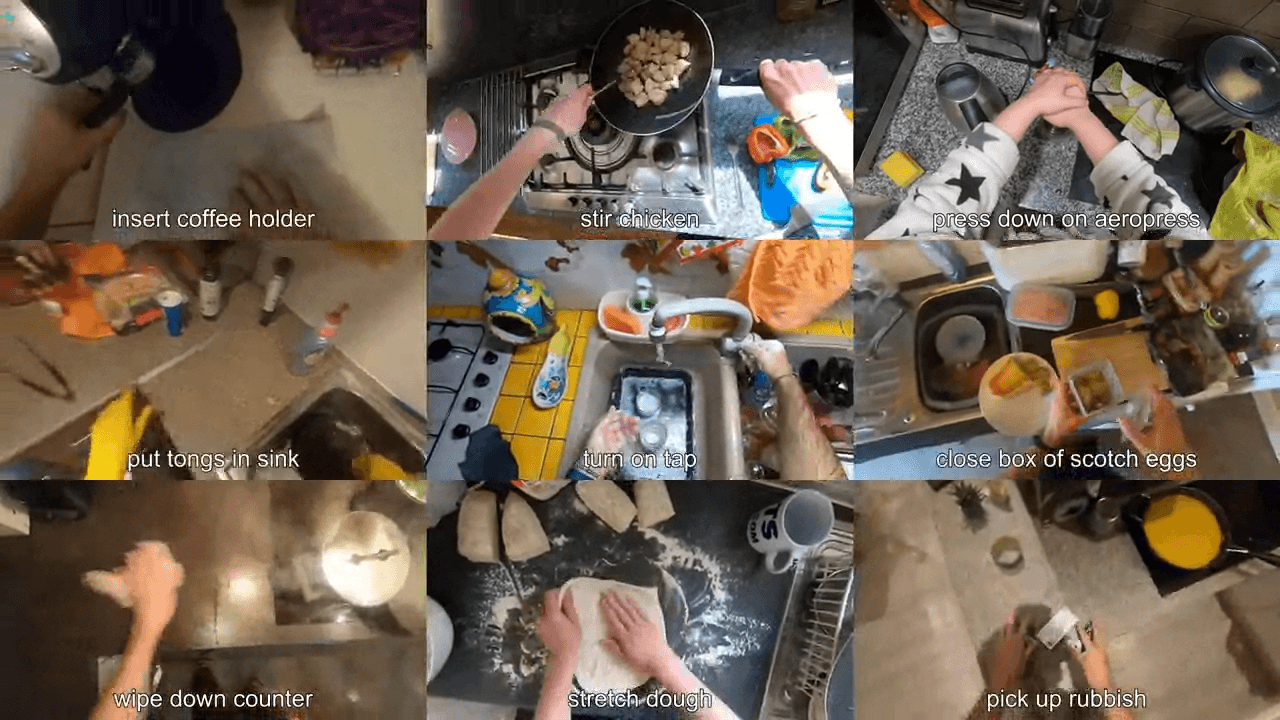
The short version
- A VLA model fuses three modalities, vision, language, and action, into a single policy.
- It maps camera frames plus an instruction like “put the mug on the shelf” directly to robot actions, no hand-coded planner in between.
- VLA models generalize across tasks and objects because they inherit a vision-language backbone; the price is data appetite, latency, and less precision than a narrow policy.
A vision-language-action model is a robot policy that borrows its brain from a vision-language model. Where a classic manipulation policy sees pixels and joint states and outputs motor commands, a VLA also reads a natural-language instruction and conditions its behavior on it. The same model that can put a block in a bowl can, given a different sentence, wipe a spill, because the task is now an input, not a separate program.
The three modalities
Vision is the robot’s cameras, wrist views, overhead views, sometimes depth. Language is the instruction, and importantly also the world knowledge baked into a pre-trained language model: what a “mug” is, that “on the shelf” means elevated and supported. Action is the output, end-effector poses, joint deltas, or gripper commands, produced as a sequence the robot executes. The insight behind VLAs is that a model already fluent in vision and language needs relatively little robot data to learn the third modality on top.
How a VLA is built
Most VLAs start from a pre-trained vision-language backbone that already grounds images in text. Training then adapts that backbone to emit actions. Two common approaches: tokenize actions into discrete bins and let the model predict them autoregressively like words, or attach a continuous action head, often a diffusion or flow-matching decoder, that generates smooth action chunks. Either way, the robot data used to fine-tune it is exactly the kind of demonstration you’d collect for imitation learning: synchronized observations, instructions, and actions. In that sense VLA model training is imitation learning with a much larger, language-aware starting point.
What VLAs are good at
Generalization is the headline. Because the backbone has seen enormous amounts of image-text data, a VLA can often handle an object or phrasing it never saw during robot fine-tuning, a red mug instead of a blue one, “tidy up” instead of “put away.” Language conditioning also means one model covers many tasks, and you steer it with words instead of retraining. This is what makes VLAs the leading candidate for a robot foundation model: a single pre-trained policy many teams adapt to their own robots.
Where they struggle
Size has costs. Large VLAs are slower to run, and hitting a real control loop rate can require distillation or a smaller action head, which is why edge inference matters in practice. They are data-hungry to fine-tune well, and on tight-tolerance tasks a focused, narrow policy trained on that one skill often beats a generalist. Choosing between a generalist VLA and a set of narrow skills is a real design decision, we cover it in atomic policies vs. end-to-end VLA models.
On Neuracore you can fine-tune an open VLA checkpoint on your own demonstrations, compare it head-to-head against a narrow imitation policy on the same evaluation set, and deploy whichever wins, with the dataset, the run, and the result all versioned together.
More on building robot skills.
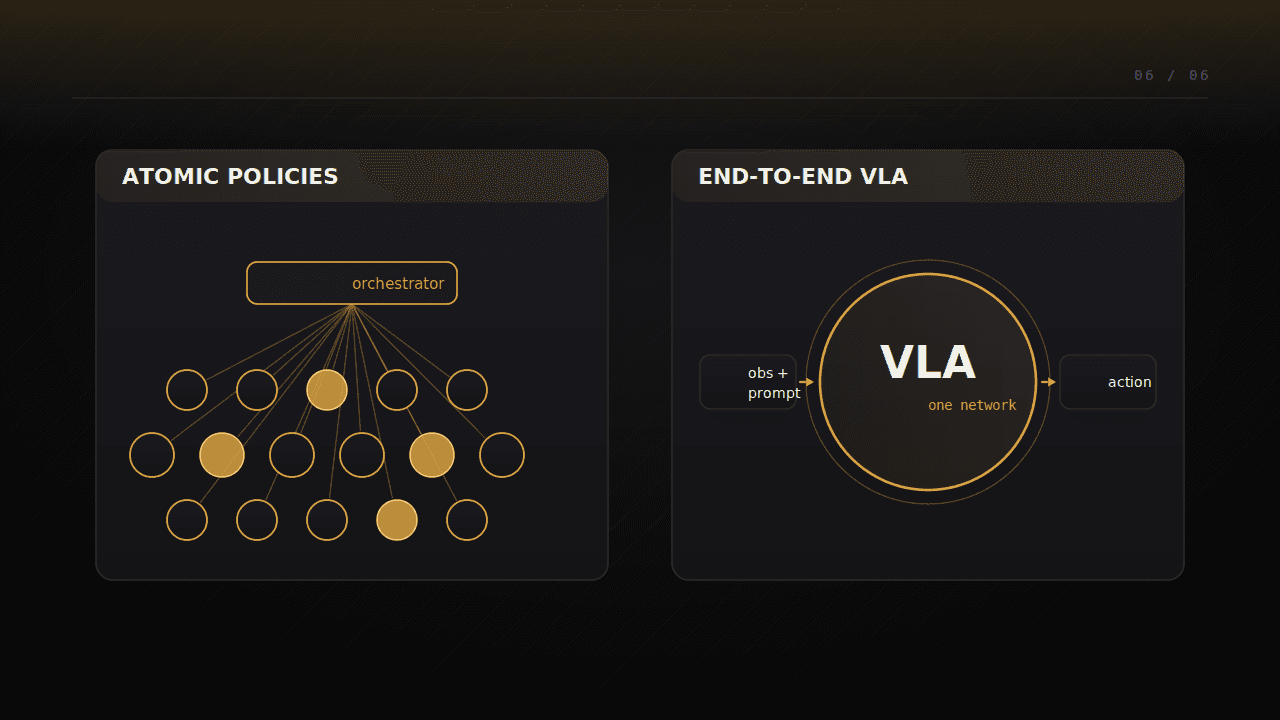
Atomic policies vs. end-to-end VLA models
Short, composable skills or one big model? The tradeoffs in reliability, data, and debugging.
Read the article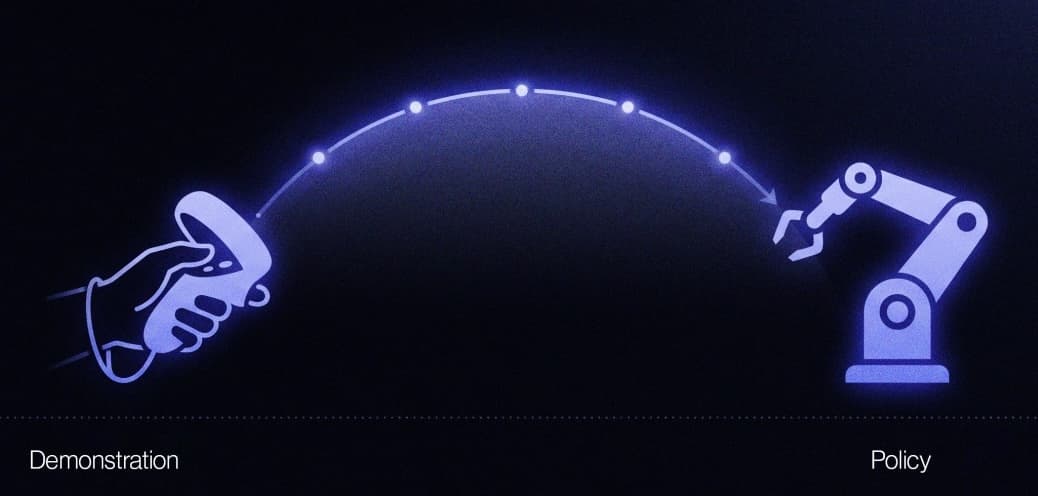
Imitation learning vs. reinforcement learning
When to clone demonstrations, when to reward-optimize, and why most policies use both.
Read the article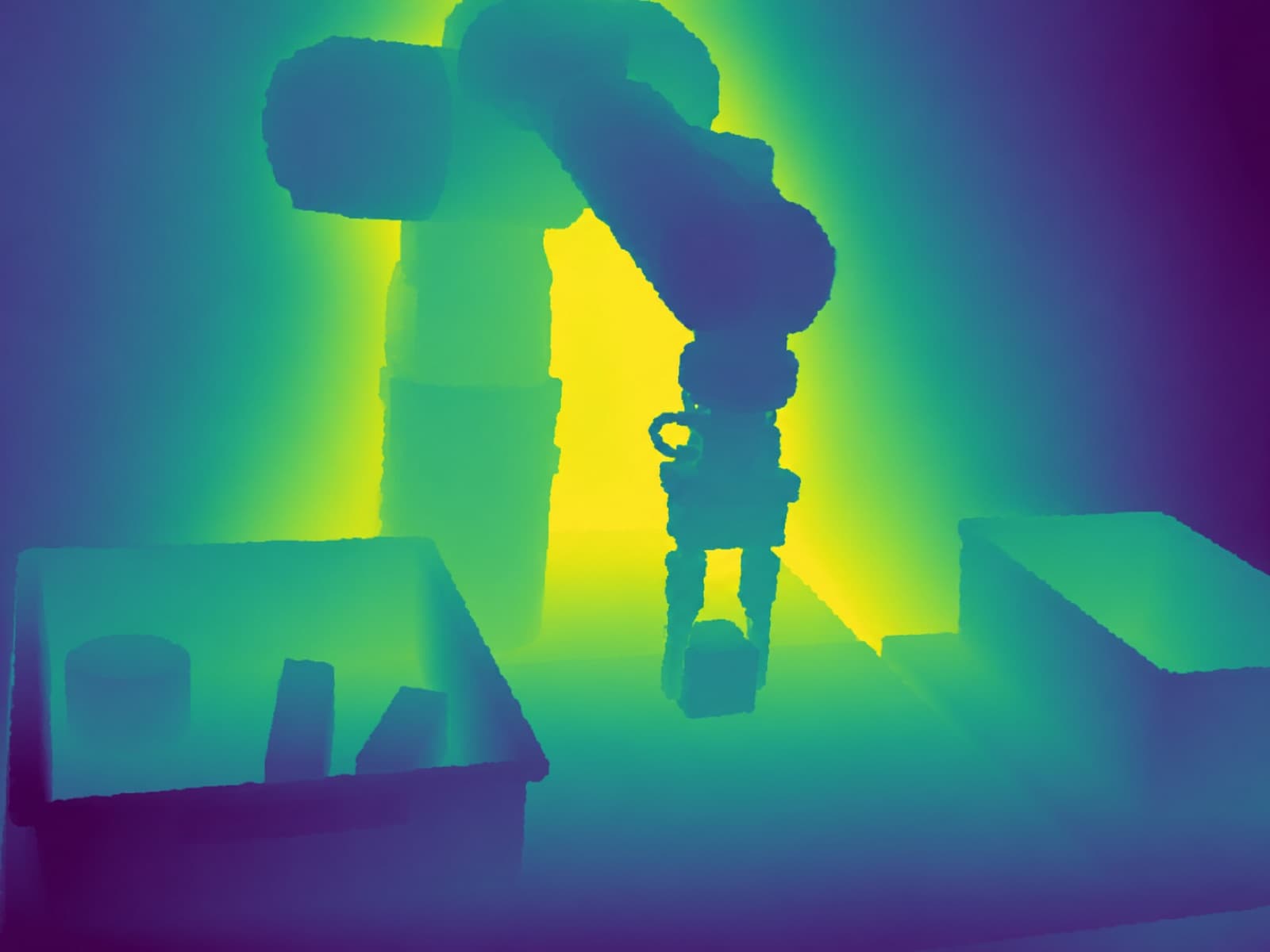
RGB vs. depth cameras for robot skill training
What RGB and depth cameras each capture, where each fails, and which your policy actually needs.
Read the articleFine-tune a VLA on your robot.
Bring your demonstrations, adapt an open VLA checkpoint, and benchmark it against narrow policies, all in one platform.