
Atomic manipulation policies vs. end-to-end VLA models
Short, composable skills or one big vision-language-action model? The tradeoffs in reliability, data, and debugging.
The short version
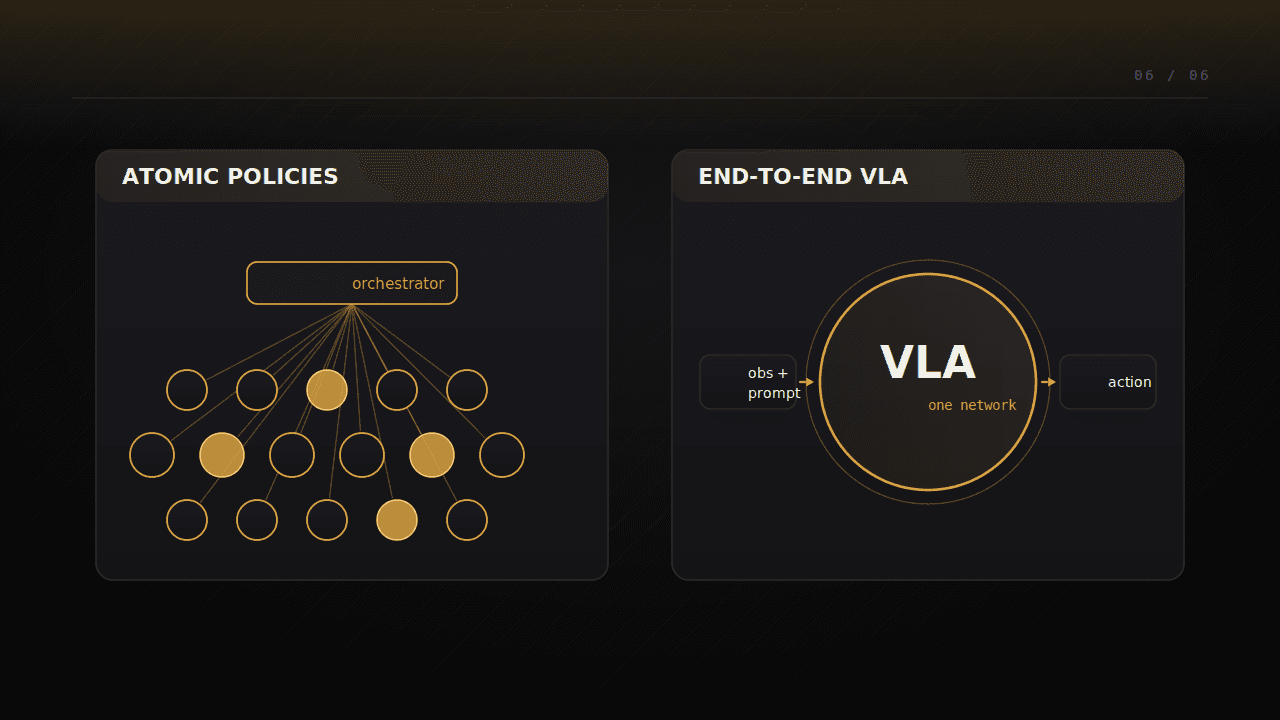
- Atomic policies are short, single-purpose skills, “grasp,” “insert,” “place”, you sequence with a planner. Reliable and debuggable, but you own the orchestration.
- End-to-end VLA models take an instruction and run the whole task in one model. Flexible and general, but data-hungry and harder to debug.
- Many production systems land in the middle: atomic skills for the precise steps, a VLA for the flexible glue.
Once you can train a manipulation policy, a design question follows: should a “skill” be a small, sharply-scoped behavior you compose with others, or should one big model swallow the entire task from instruction to finish? This is the atomic-versus-end-to-end debate, and it shapes how you collect data, how you debug failures, and how reliable the system is in production.
The atomic approach
An atomic policy does one thing: pick up the connector, seat it, place the part in the tray. Each is trained and evaluated on its own narrow slice, and a higher-level planner or state machine sequences them into a full task. The advantages are concrete. Each skill needs far less data because its scope is small, and it can hit very high reliability on that scope. When something fails you know which skill failed and can improve it in isolation. And you reuse skills, “grasp” learned once serves many tasks. The cost is orchestration: you own the logic that decides what runs when, and stitching brittle transitions between skills is real work. The seams between skills are where these systems break.
The end-to-end approach
An end-to-end VLA model collapses the pipeline: give it cameras and “assemble the kit,” and it produces actions for the whole task, transitions included. There’s no hand-built planner and no brittle seams, the model learns the flow. It generalizes across tasks and objects thanks to its language-vision backbone, and you steer it with instructions rather than reprogramming. The tradeoffs mirror the atomic ones. It needs much more data because it’s learning the entire task distribution at once, and precision on tight-tolerance sub-steps can lag a dedicated skill. Debugging is harder: when it fails mid-task, “which part broke” has no clean answer, the whole model is implicated, and the fix is usually more targeted data.
How to actually choose
Favor atomic skills when reliability and traceability dominate, when steps are precise and well-defined, and when you want to reuse behaviors across products. Favor an end-to-end VLA when tasks are varied and long-horizon, when writing the orchestration by hand is more painful than collecting data, and when flexibility to new instructions matters more than squeezing the last point of precision. The two also sit on the same data-cost curve from opposite ends: atomic skills spend less data per skill but more human orchestration; end-to-end spends more data but less hand-built logic.
The middle usually wins
In practice the strongest systems are hybrids: atomic policies for the precise, high-stakes steps where you need guaranteed reliability, and a VLA handling the flexible, variable glue between them. What makes that practical is having both live in the same place. On Neuracore you can train narrow atomic policies and fine-tune a generalist VLA on the same demonstrations, evaluate them on shared benchmarks, and compose them however the task demands, instead of committing to one philosophy before you’ve measured which parts of the job actually need which.
More on building robot skills.
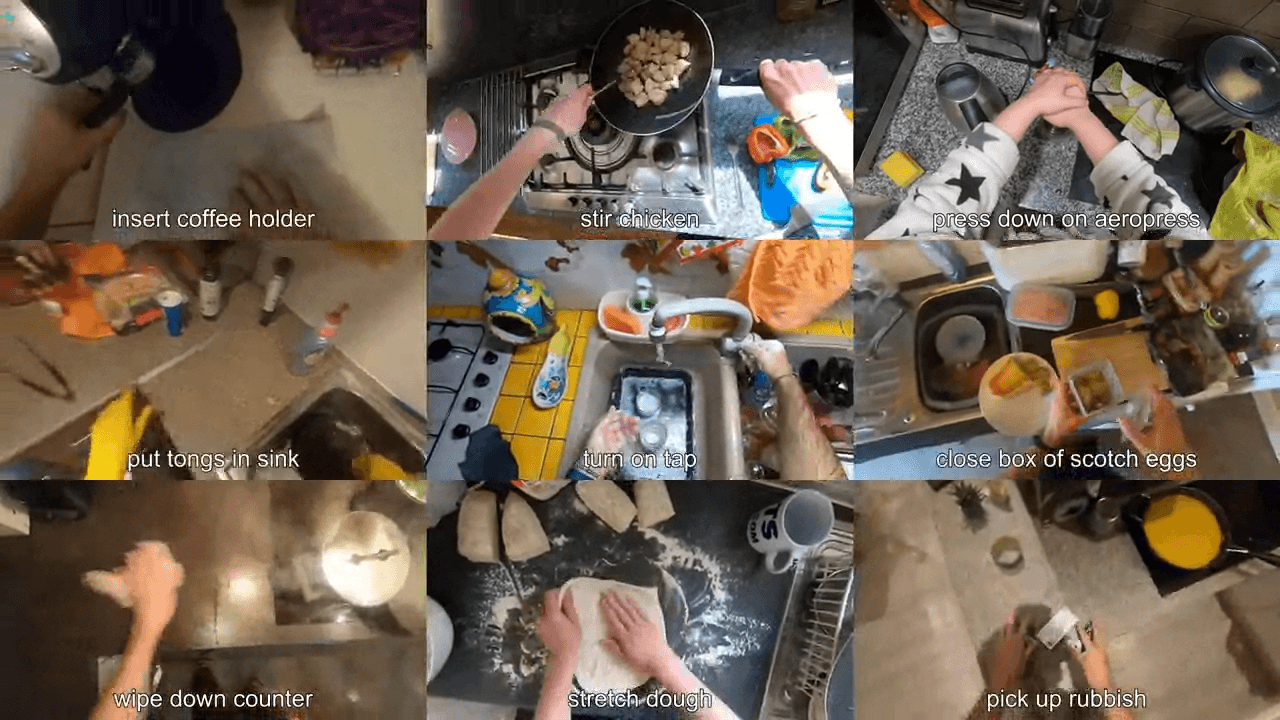
What is a Vision-Language-Action (VLA) model?
How VLA models map camera frames and language instructions straight to robot actions, and where they fit.
Read the article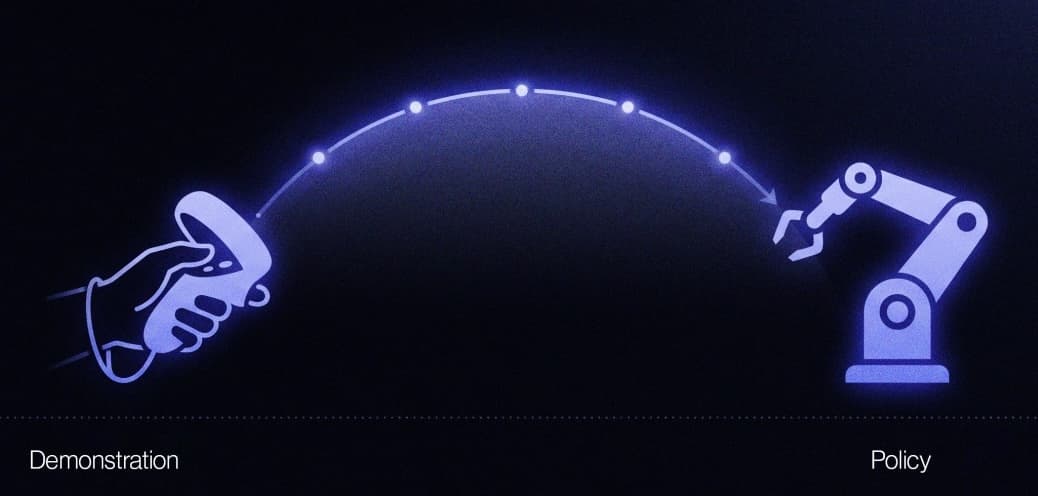
Imitation learning vs. reinforcement learning
When to clone demonstrations, when to reward-optimize, and why most policies use both.
Read the article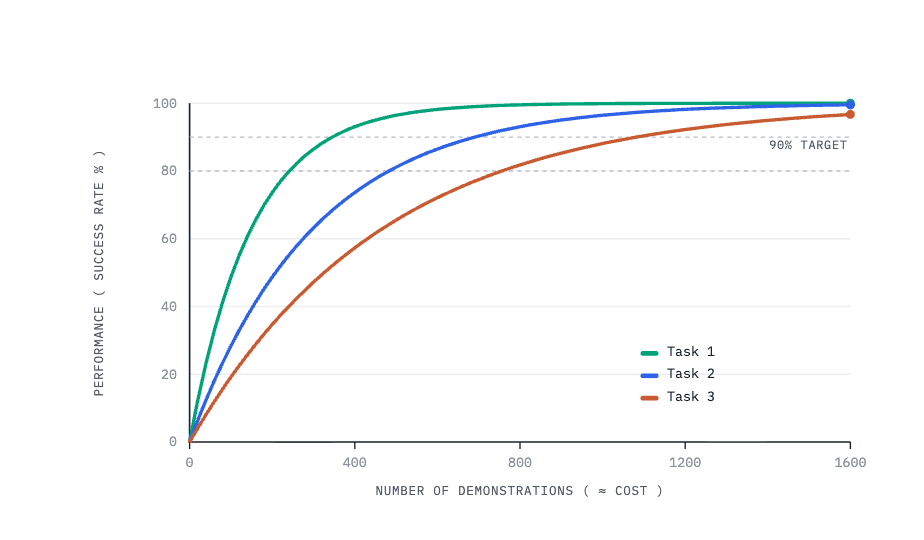
Robot skill scaling laws
How success rate scales with demonstrations, and what a new skill really costs in data and compute.
Read the articleTrain atomic skills and VLAs side by side.
Neuracore lets you build narrow policies and generalist VLAs on the same data and benchmark them on shared evaluations.