Imitation learning vs. reinforcement learning for robot manipulation
When to clone demonstrations, when to reward-optimize, and why nearly every production manipulation policy ends up using both.
The short version
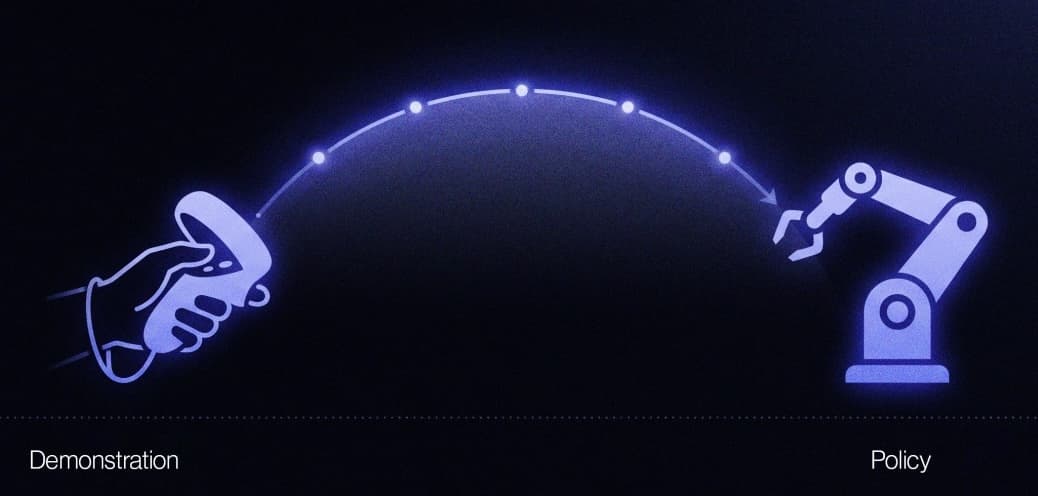
- Imitation learning copies human demonstrations. It is fast, sample-efficient, and the default way to get a first working manipulation policy.
- Reinforcement learning optimizes a reward through trial and error. It fixes the long tail imitation can’t reach, at the cost of more rollouts and reward engineering.
- In production you usually pre-train with imitation learning and then fine-tune with reinforcement learning, which is why a robot reinforcement learning platform and an imitation learning platform should be the same system, not two.
Both imitation learning (IL) and reinforcement learning (RL) produce a policy: a function that maps what the robot senses, camera frames, joint angles, gripper state, to what it should do next. The difference is entirely in where the learning signal comes from. That single distinction drives everything else: how much data you need, how you collect it, how long training takes, and how the policy fails.
What imitation learning actually does
Imitation learning treats manipulation as supervised learning. You collect demonstrations, a person teleoperating the robot to fold a shirt, seat a connector, or unload a rack, and each demonstration becomes a stream of observation-action pairs. The policy is trained to reproduce the demonstrated action given the observation. The simplest form, behavior cloning, is exactly that: predict the human’s next action. More capable variants like ACT (action chunking transformers) and diffusion policies predict short sequences of actions and model the fact that a human might solve the same state several valid ways.
The appeal is efficiency. A competent grasp-and-place skill can emerge from a few hundred good demonstrations because every frame is a labeled example of the right thing to do. There is no exploration, no reward to design, and no risk of the robot flailing through millions of failed attempts. This is why almost every team’s first working policy is an imitation policy, and why how you collect demonstrations matters so much: the policy is only as good as the behavior you showed it.
Its weakness is the flip side of the same coin. A behavior-cloned policy only knows the states its demonstrations covered. Let it drift somewhere a human never went, a slightly different grasp angle, an object nudged out of place, and errors compound, because now it is predicting from observations unlike anything in its training set. Techniques like DAgger address this by collecting corrective demonstrations in the exact states the policy visits, but fundamentally, imitation learning cannot exceed the quality of what it was shown.
What reinforcement learning actually does
Reinforcement learning removes the human from the label loop and replaces them with a reward. You define what success means, the connector is seated, the cube is in the bin, and the policy improves by trying actions, observing outcomes, and shifting probability toward whatever earned reward. Because the signal comes from the environment rather than a fixed dataset, an RL policy can discover behaviors no one demonstrated and can, in principle, surpass human performance on the metric you specified.
That freedom is expensive. Learning from reward requires exploration, and exploration on real hardware means thousands of rollouts, contact events, and resets you have to supervise. So most manipulation RL runs at least partly in simulation, where rollouts are cheap and parallel, which turns policy quality into a sim-to-real problem. RL is also sensitive to reward design: a reward that is technically satisfiable without doing the task will be gamed, and reward shaping is genuine engineering work, not a checkbox.
Where each one wins
Reach for imitation learning when the task is well-defined by human intuition and you can demonstrate it, when you need a working policy quickly, and when data, not reward design, is your available lever. Reach for reinforcement learning when you need to push past a plateau imitation hit, when success is easy to measure but hard to demonstrate consistently (dynamic, contact-rich, or high-precision tasks), or when you want the policy to be robust to states humans rarely produce on purpose.
In practice the honest answer for most robot manipulation policy training is: don’t choose. A policy cloned from a few hundred demonstrations gives you an 80%-success starting point in days; reinforcement learning fine-tuning grinds the last stubborn failure modes down over the following weeks. Starting RL from a good imitation policy also sidesteps its worst problem, early exploration, because the policy already behaves sensibly on day one instead of exploring at random.
Why they belong on one platform
If imitation and reinforcement learning live in separate tools, the handoff between them becomes the bottleneck. The imitation policy, the demonstrations it trained on, the reward, and the simulated and real rollouts all have to reference the same dataset and the same versioned model, otherwise you can’t tell whether an improvement came from new data, a new reward, or a new architecture. That’s the whole argument for running the loop in one place: collect demonstrations, train an imitation policy, fine-tune it with reinforcement learning, deploy it, and feed production failures back as new demonstrations, with every step versioned against the same data.
More on building robot skills.
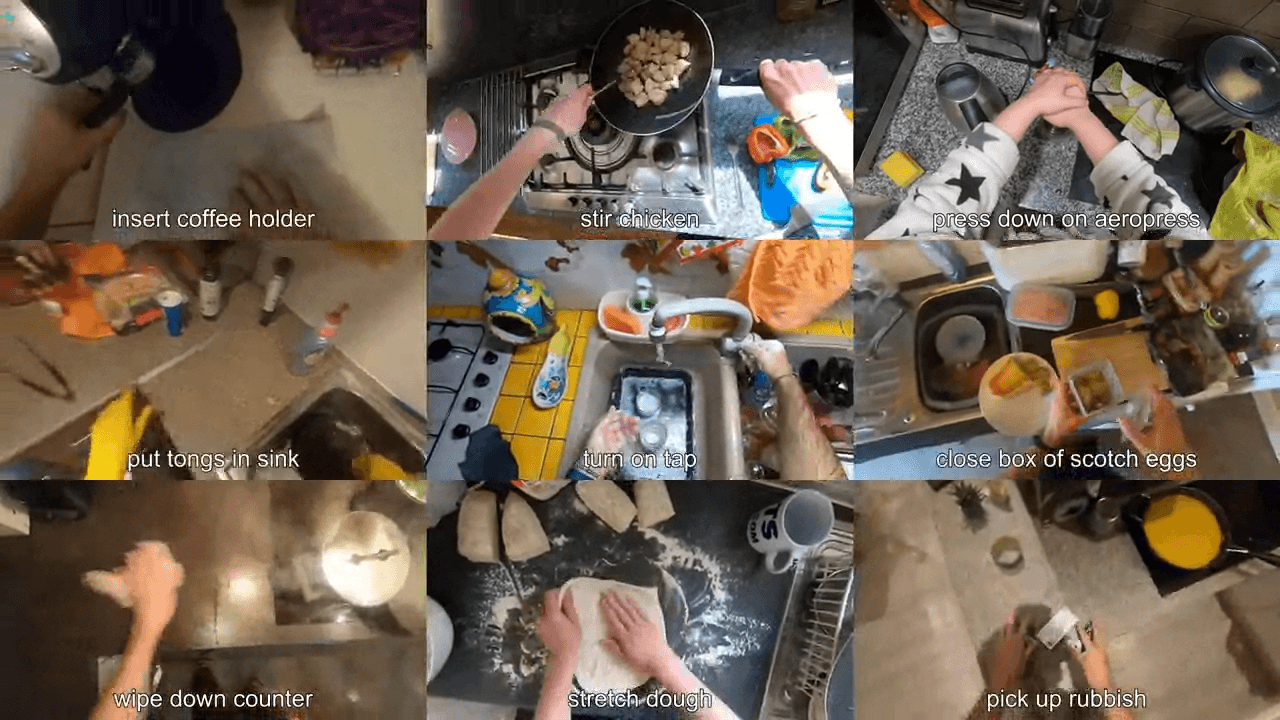
What is a Vision-Language-Action (VLA) model?
How VLA models map camera frames and language instructions straight to robot actions, and where they fit.
Read the article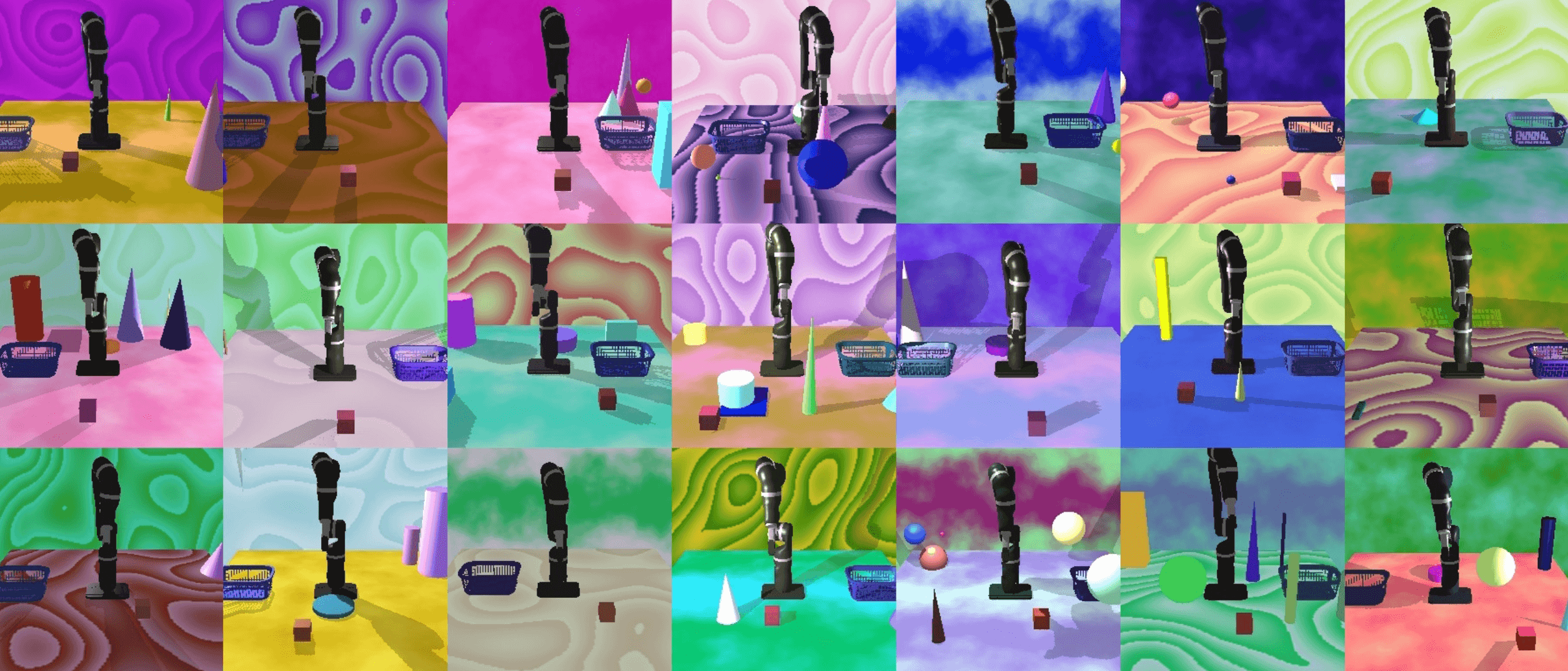
Sim-to-real: mixing simulated and real data
How much simulation helps, where it breaks, and how to blend sim and real rollouts.
Read the article
What is Physical AI?
AI that perceives and acts in the real world, and how imitation learning, reinforcement learning, and robotics fit together.
Read the articleRun imitation and RL on the same data.
Neuracore pre-trains manipulation policies with imitation learning and fine-tunes them with reinforcement learning, versioned end to end, from teleoperation to deployment.